Banksy has never officially revealed his identity, and his anonymity is considered a core part of his artistic practice.
Whether addressing anti-war sentiments, surveillance, or inequality, Banksy’s work resonates worldwide. Several iconic works by Banksy in London reflect his ongoing engagement with political and social issues, making the city a significant canvas for his artistic voice.
This page explores Banksy’s biography and artistic evolution, alongside the Banksy exhibition at Moco Museum London, where authenticated works are presented in a curated museum experience. The Banksy exhibition in London at Moco Museum offers visitors a curated entry point into the rebellious world of the anonymous street artist.
Technique: How Banksy Creates His Art
Banksy is known for using stencil techniques, allowing him to create detailed works quickly in public spaces while maintaining anonymity.
The shift from freehand graffiti to stencils enabled speed, precision and repeatability. This allowed Banksy to place meaningful imagery in highly visible urban locations, especially across London.
Early Career and the Bristol Underground Scene (1990–1999)
Banksy’s evolution from Bristol street artist to global icon can be traced through key milestones: emerging in the 1990s underground scene, adopting stencil techniques in the early 2000s, expanding into London’s public spaces, staging exhibitions like Turf War and Barely Legal, releasing the film Exit Through the Gift Shop, creating Dismaland in 2015, and disrupting the art market with record-breaking auction moments such as Love is in the Bin.
Banksy’s story begins in Bristol, a city shaped by music, subculture and rebellion. In the 1990s, he emerged from the underground graffiti scene, where artists worked quickly, often illegally, and always under pressure.
Influenced by the rise of hip-hop culture and the raw immediacy of street expression, Banksy initially worked freehand. This approach, however, proved limiting in fast-paced urban environments where time meant risk.
What defined this early period was not just style, but intent. Even then, his work carried a sharp social awareness, challenging authority, capitalism and control. Bristol became both a training ground and a testing space for ideas that would later reach a global audience.
The Transition to Stencils and London Expansion (2000s)
The shift to stencil-based graffiti marked a turning point in Banksy’s evolution. Stencils allowed for speed, precision and repeatability, enabling him to place impactful images in highly visible urban locations.
Banksy began using stencils in the late 1990s to work faster, a technique that became central to his visual identity.
As his style evolved, so did his reach. Moving beyond Bristol, Banksy’s works began appearing across London. The city’s walls became his canvas, transforming public space into a platform for commentary.
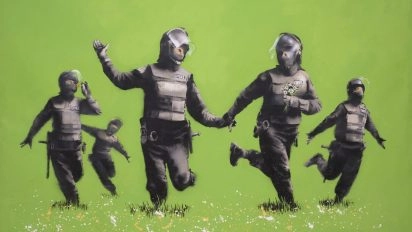
This period introduced some of his most recognisable visual language: rats, police figures, children and surveillance imagery. These symbols carried layered meaning while remaining instantly accessible, a balance that helped define his global appeal.
Themes in Banksy’s Work
Banksy’s work consistently explores themes that remain globally relevant:
- Anti-war and political resistance
- Surveillance and control
- Consumerism and capitalism
- Social injustice and inequality
- Satire and dark humour
These themes appear through recurring visual symbols such as rats, police, children, and CCTV cameras.
Key Career Milestones: From Turf War to Dismaland
Banksy’s rise from street artist to global cultural force is marked by a series of pivotal moments:
Turf War (2003, London): His first major exhibition challenged traditional gallery norms, featuring live animals and politically charged installations.
Barely Legal (2006, Los Angeles): Cemented his international reputation and attracted celebrity collectors.
Exit Through the Gift Shop (2010): An Oscar-nominated film that blurred the line between art, authorship and satire.
Dismaland (2015, Weston-super-Mare): A dystopian theme park marked by institutional critique.
Auction disruption (2018): Girl with Balloon self-destructed at Sotheby’s, becoming Love is in the Bin and redefining the relationship between art and commerce.
Banksy’s career is defined by disruptive moments that challenge institutions, from gallery exhibitions to auction houses and installations.
These milestones reflect a consistent pattern: Banksy does not adapt to the art world. He reshapes it.
Evolution of Style: Freehand vs. Stencil Technique
Banksy’s early freehand graffiti carried the raw energy of traditional street art, but lacked efficiency. The adoption of stencils introduced a new level of clarity and speed.
With stencils, images became sharper, messages more immediate. This shift allowed Banksy to communicate political ideas in a single, striking visual moment.
Stencil work also enabled repetition. A single image could appear across cities, reinforcing its message and building recognition. This reproducibility played a key role in transforming Banksy from a local graffiti artist into a global voice.
Timeline of Banksy’s Career
| Year | Location | Key Event |
| 1990s | Bristol | Emerges in underground graffiti scene |
| Late 1990s | UK | Begins using stencil technique |
| Early 2000s | London | Expands street presence across the city |
| 2003 | London | Turf War exhibition |
| 2006 | Los Angeles | Barely Legal exhibition |
| 2010 | Global | Exit Through the Gift Shop released |
| 2015 | UK | Dismaland opens |
| 2018 | London | Love is in the Bin auction event |
Where Can You See Banksy’s Art?
Banksy’s works can be found on public walls worldwide, in private collections and in museum exhibitions.
His art appears across major cities including London, where many of his most iconic public works first gained attention.
Banksy at Moco Museum London
The Banksy exhibition at Moco Museum London presents authenticated works verified by Pest Control, offering a curated museum experience of the artist’s work.
Hosted at Moco Museum London, this exhibition gives art lovers the opportunity to encounter authenticated works that highlight Banksy’s unique voice and lasting impact on contemporary art.
Girl with Balloon (2004)
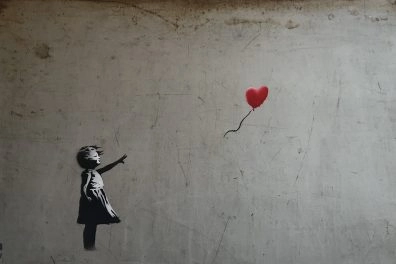
One of Banksy’s most famous and emotionally charged pieces, Girl with Balloon first appeared on a wall in Southbank, London, in 2002. It depicts a young child reaching out for a heart-shaped balloon that is drifting away. The accompanying phrase, “There is Always Hope,” transforms the image from a melancholic scene of loss into a symbol of optimism.
The heart-shaped balloon symbolises innocence and love, while the outstretched hand reflects vulnerability and longing. In 2018, a framed version of the painting famously self-destructed during a Sotheby’s auction, an event orchestrated by Banksy himself. The shredded work was renamed “Love is in the Bin”, turning the moment into an art world scandal and reinforcing Banksy’s critique of art’s commodification.
Love is in the Air (2005)
‘Love is in the Air’, also known as Flower Thrower, was first created on a wall in Bethlehem in 2003. The piece depicts a masked protestor, poised to throw a bouquet of flowers rather than a Molotov cocktail. This juxtaposition of aggression and peace underscores Banksy’s anti-violence message.
The work’s black-and-white figure contrasts with the colourful, hand-painted flowers, reinforcing the theme that peace and violence are opposing yet interconnected forces. This iconic example of Banksy art highlights how the artist uses symbolism to challenge social and political norms. ‘Love is in the Air’ has since become one of the most widely recognised symbols of modern political activism.
Di-Faced Tenners (2004)
In 2004, Banksy created thousands of altered £10 notes featuring Princess Diana’s face instead of Queen Elizabeth II’s. The note also reads “Banksy of England” and carries the motto “Trust No One”, a direct critique of the British monarchy and the financial establishment.
These fake notes were printed with inks and paper almost identical to official UK currency and were distributed at events like the Notting Hill Carnival and Reading Festival – with some people even attempting to use them as real money. Today, the Di-Faced Tenners serve as a reminder of Banksy’s ability to challenge authority and question societal norms through subversive humour.
Smiling Copper
‘Smiling Copper’ presents a life-size riot policeman, dressed in full protective gear, with a bright yellow smiley face replacing his head. The unsettling contrast between the threatening body language and the cheerful symbol of a smiley face reflects Banksy’s critique of authority figures and the abuse of power.
The smiley face evokes the 1990s acid house movement, but in this context, it suggests the forced projection of friendliness as a façade for control and surveillance.
“Are we really smiling, or just pretending to?” — Banksy
CCTV (1998)
‘CCTV’ presents two surveillance cameras depicted as scorpions, pointing toward each other in a state of mutual observation. Banksy’s satirical commentary on the rise of surveillance culture raises questions about privacy, security, and state control.
This piece critiques the omnipresence of surveillance in modern society, highlighting the paradox that while cameras are meant to protect, they often serve as tools of oppression.
“Who’s watching the watchers?” — Banksy
The immersive exhibition London meets Banksy
This immersive exhibition allows visitors to step into Banksy’s world, making it feel more like a true Banksy museum than a traditional gallery space. The exhibition transforms traditional gallery viewing into an engaging, up-close experience. Discover iconic works such as Flower Thrower, Laugh Now, and Smiling Copper, and explore the layered meanings behind Banksy’s visual language.
The exhibition contributes to the growing cultural appreciation of Banksy in London, England. This is a city where his public works have sparked both public debate and widespread media attention. Banksy’s art extends beyond indoor exhibitions, with outdoor murals that have become part of London’s cultural landscape.
Banksy’s Legacy and Impact
Banksy’s legacy extends beyond graffiti walls. He has disrupted auction houses, influenced pop culture, and helped legitimize street art as contemporary art. His work, regularly resold for millions, continues to shape how urban scenography is viewed in elite art circles.
By using art as a tool for activism, Banksy invites viewers to confront uncomfortable truths about society, consumerism, and authority. His work continues to challenge conventions, inspire dialogue, and remind us that art is not confined to a singular definition.
Through satire and subversion, Banksy invites us to question the systems we inhabit. His murals on city walls and urban art installations serve as critiques of capitalism, war, and media.
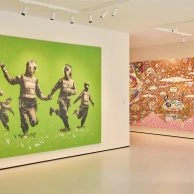
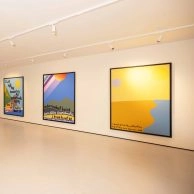
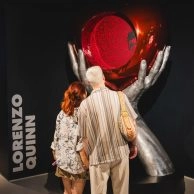
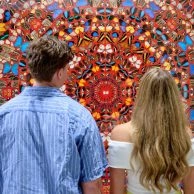
Exhibiting artists include



Reviews
Practical Information
-
Opening Hours
Monday – Thursday: 10:00 – 19:00
Friday – Saturday: 10:00 – 20:00
Sunday: 10:00 – 19:00
-
Duration
Approximately 90-120 minutes
-
Location
1-4 Marble Arch, London, UK.
Get directions via this link. Check out things to do in the area!
-
Contact
Email us at [email protected] or visit our contact page.
-
Audio tour
Free audio tour, bring your headphones.
-
About
Moco Museum London is an independent modern and contemporary art museum presenting influential contemporary voices including Banksy, Warhol, Basquiat, Haring, Kusama, and Robbie Williams, focused on modern, contemporary, digital and immersive art that reflects life today.
Reviews Media
-
 Head to the newly opened Moco Museum to find iconic works celebrated by modern artists and upcoming stars. Featuring works from “Moco Masters” Andy Warhol, Jean-Michel Basquiat and Keith Haring, the Moco Museum is home to a vast range of iconic and daring creations.
 -
 Head to the newly opened Moco Museum to find iconic works celebrated by modern artists and upcoming stars. Featuring works from “Moco Masters” Andy Warhol, Jean-Michel Basquiat and Keith Haring, the Moco Museum is home to a vast range of iconic and daring creations.
 -
 The scale of Moco Museum's London flagship is so impressive, it allows room for colossal, vital pieces by the likes of Daniel Arsham and Damien Hirst to sit alongside crowd-pleasers like Banksy's Flower Thrower. A must for any art lover and highly recommended.
 -
 Iconic works by internationally renowned artists and rising stars.
 -
 Experience the transformative power of performance art.
"Hope is fragile, but it always finds a way."
Exhibitions Featuring This Artist
FAQ
When did Banksy start his art career?
Banksy began his career in the early 1990s in Bristol’s underground graffiti scene.
What is the significance of the stencil in Banksy’s work?
Stencils allow Banksy to create fast, precise artworks in public spaces while maintaining anonymity.
How did Banksy transition from street art to galleries?
Banksy transitioned through exhibitions such as Turf War and Barely Legal, bringing street art into gallery and institutional contexts.